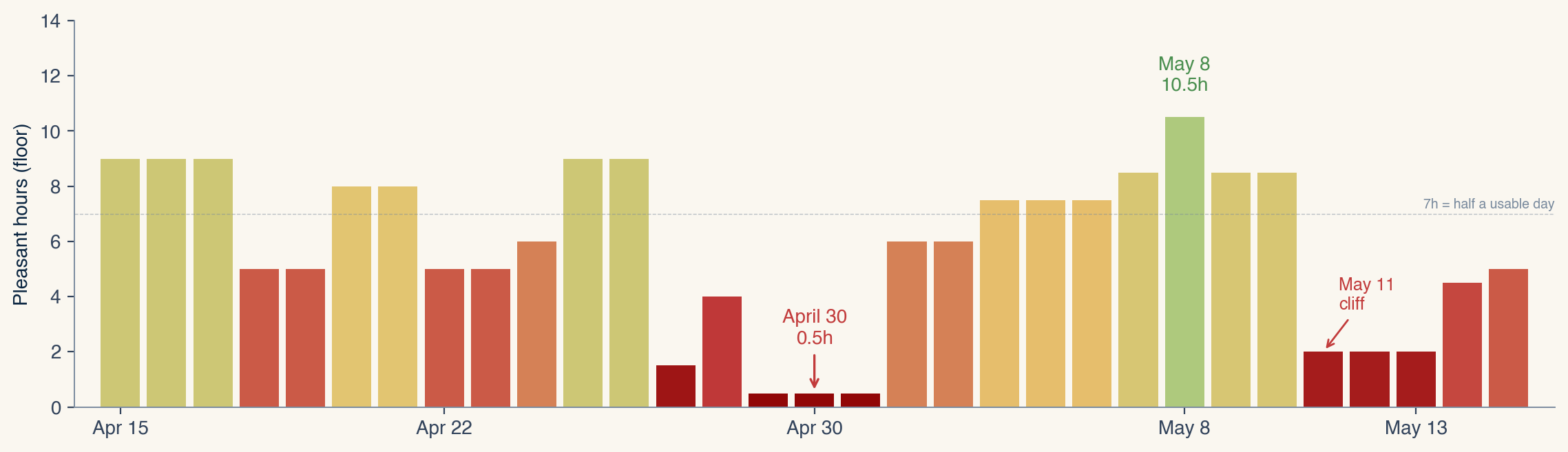
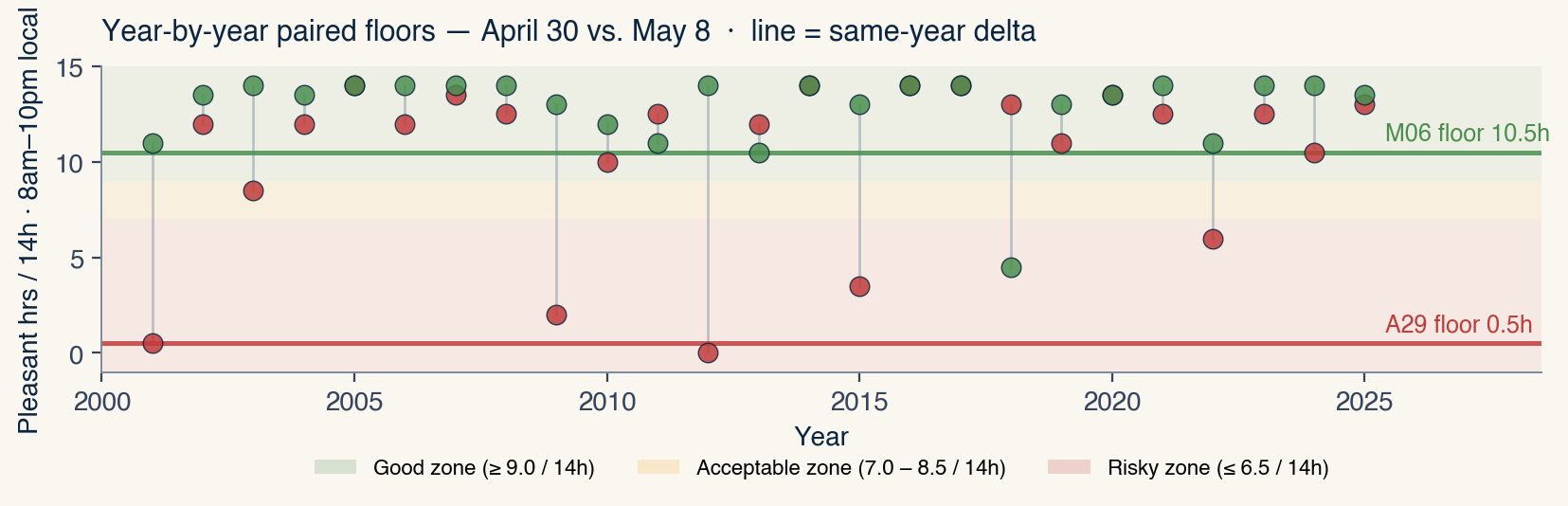
Daytime (8am–10pm), audited over 25 years.
The rain you avoid. The comfort your people will actually feel. Daytime hours, 8am–10pm local. Audited, not averaged.
April 30: 0.5 hrs of pleasant outdoor time held in 24 of 25 years. May 8: 10.5 hrs. Same venue. Eight days apart.
The 25-year audit shows the difference the decision-maker can't see. See the full audit ↓
A forecast says what's coming in the next days. An average says what's typical. Forelore tells you which dates hold the highest pleasant-hours floor — the daytime hours that have held up in 24 of 25 years over the last quarter-century.
10-day outlook, hour by hour. Useful 7 days out, useless 18 months out when the booking is made.
Numbeo, Wikipedia, climate.gov. Average pleasant hours hide the variance — and an outdoor event is one specific day.
For your venue, on this date, the floor of pleasant daytime hours that held in 24 of 25 years — observed, not modeled.
Two dates, eight days apart, both inside what every wedding calendar calls "peak shoulder" season. The 25-year audit shows one is a cliff, the other is the start of a four-day sweet spot.
Same venue, 8 days apart. +10.0 hours of usable outdoor time per day.
Industry says peak season. The audit says not until May 7.
The atomic unit is one venue-date (1 venue × 1 date). Every tier delivers the same audit-grade PDF — same methodology, same 25-year data. Tiers differ in volume, geographic coverage, and workflow features. Monthly billing available on every paid tier · cancel anytime · venue-dates delivered at a steady monthly pace (5 / 15 / 30 per tier).
A region = 150-mile radius around any centroid you declare. Pricing in USD, indicative — final terms confirmed via consultation. All tiers cancel anytime. Annual prepay saves 17% — same monthly venue-date delivery rate.
Forelore's audit engine answers two queries over the same 25-year climate floor dataset:
"At this venue, when?"
You give a venue. The audit returns the year-round rhythm of pleasant hours — 365 days of floors — to compare candidate dates, identify sweet-spot windows, or score the full annual fingerprint.
"On this date, where?"
You give a date or window. The audit returns the global ranking — 5.4 million distinct points — to compare candidate destinations, build short-lists, or rotate a portfolio of venues.
The Harbor Island case study above is the first query type, applied to a wedding date selection. The same engine serves vacation rentals, property buys, festivals, multi-venue portfolios, and destination comparisons.
Forelore audits at 0.1° lat/lon resolution — each pixel is approximately 11 km × 11 km, the size of a small coastal town. Two villas 20 km apart on the same coast may have meaningfully different floors. The audit is venue-specific: your exact location, not a regional or city-level smoothed average.
An outdoor event lives or dies on rain. Forelore uses NASA GPM IMERG Final V07 — the gold-standard satellite precipitation dataset, with 0.1° lat/lon resolution (~11 km) and 30-minute temporal cadence. Each 30-minute slot counts as rain-free below 0.1 mm/h rain rate. No rain, no event lost.
Why satellite rain, not reanalysis? Validated against NOAA Stage IV gauge ground truth, ERA5 reanalysis exhibits a −2.3-hour drizzle bias in places like Miami — counting low-rate rain the gauges don't register. IMERG matches the gauge within ±0.4 hours. The choice of rain dataset alone can shift the audit by hours per day.
Once rain has cleared, what's left is thermal comfort. A 30°C day with full sun, no wind, and 80% humidity feels around 38°C to a person standing outside in formal clothing — the thermometer reads 30°C, the body feels 38°C. Forelore measures what your people actually feel, using the UTCI (Universal Thermal Climate Index) — the scientific standard for outdoor thermal stress.
UTCI consumes air temperature, mean radiant temperature (sun + ground + buildings), wind speed, and water vapor pressure (humidity). It accounts for all of them simultaneously using a 6th-order polynomial fit (Bröde et al. 2012, IJBM). Below −13°C or above +32°C UTCI, the body experiences strong thermal stress — those hours are excluded from "pleasant" in the audit. The UTCI dataset is Di Napoli et al. 2021 (DOI 10.1002/gdj3.102), published in Geoscience Data Journal.
When Forelore reports a "high-confidence floor" of X hours of pleasant weather, what we mean is: at this venue × date, 24 of the last 25 observed years matched or exceeded this floor. That works out to approximately 90% one-sided confidence — the inter-annual climate variability has been measured directly, not modeled.
Why "~90%" and not "96%" (= 24/25 raw)? Because successive climate years are not statistically independent. Multi-year cycles like ENSO and AMO mean that 25 calendar years carry roughly 18–22 effective independent samples. After accounting for that autocorrelation, the confidence is conservative at ~90%.
What this means for you: in any single future year at this venue on this date, there is approximately a 1-in-10 chance that the pleasant-hours value will fall below the floor. The audit's job is to tell you what the worst plausible value has been.
ENSO sensitivity: our 2001–2025 sample contains 3 La Niña / 5 El Niño / 17 Neutral years (long-run climatology ~25/30/45%). Bootstrap re-weighting to climatological ENSO frequencies moves the audited floor by ≤0.3 hours — the 2nd-lowest order statistic already absorbs the worst La Niña year in the sample directly.
Full statistical derivation (Weibull plotting position, climate-autocorrelation adjustment via Bretherton 1999 + Wilks 2011, ENSO robustness analysis, references to David & Nagaraja 2003 and IPCC AR6): read the methodology note.
What Forelore's audit serves today: any single-event venue × date decision — outdoor weddings, vacation rentals, property use-week selection, festivals, single corporate events. Multi-venue annual profiles and portfolio reports are on the Q3 2026 roadmap.
Tell me the venue (or coordinates), and one or two dates. I'll generate a Forelore PDF audit and send it back within 24-48 hours. No signup. No card. If the data tells you what you needed, we talk about a Pro Planner subscription or a property-portfolio pilot.